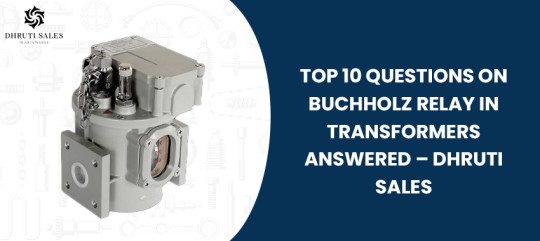
The Buchholz Relay is one of the most important protective devices for oil-immersed power transformers. It detects faults early and prevents severe damage. At Dhruti Sales, we often get queries from engineers, students, and industries about how this device works, why it is needed, and how to maintain it. In this blog, our experts answer the Top 10 FAQs on Buchholz Relay in Transformers to make your understanding easier.
Frequently Asked Questions (FAQs)
Q1. What is a Buchholz Relay in a Transformer?
A Buchholz Relay is a gas-actuated protective device used in oil-filled transformers with a conservator tank. It detects gas produced by internal faults or abnormal conditions and triggers an alarm or trips the circuit breaker.
Q2. Why is the Buchholz Relay important?
The Buchholz Relay provides early fault detection by sensing gas bubbles or oil movement inside the transformer. Without it, minor issues could grow into major failures like fire, explosions, or transformer breakdowns.
Q3. Where is the Buchholz Relay installed?
It is fitted in the pipeline between the main transformer tank and the conservator tank. This position allows it to sense both gas accumulation and oil flow disturbances effectively.
Q4. How does a Buchholz Relay work?
The relay has two floats:
Q5. What types of faults can the Buchholz Relay detect?
It responds to:
Q6. What are the different types of Buchholz Relays?
At Dhruti Sales, we supply:
GOR-1 – For small and medium transformers
GOR-2 – For higher-rated transformers
GOR-3 – For large-capacity units
These relays are manufactured as per IS 3347 / IS 8603 standards for maximum reliability.
Q7. What is the working principle of the Buchholz Relay?
It works on the principle of gas collection and oil flow detection. Internal faults produce gases that rise to the relay chamber, operating the float switches. In case of severe faults, sudden oil displacement activates the trip mechanism.
Q8. How do you test a Buchholz Relay?
Testing involves:
Injecting air into the relay to simulate gas accumulation.
Checking the alarm circuit response.
Creating oil flow conditions to test the trip circuit.
Inspecting for leaks or float malfunctions.
Routine testing ensures the relay functions properly during emergencies.
Q9. What are the advantages of using a Buchholz Relay?
Early warning before major breakdowns
Protects against costly transformer failures
Simple construction and high reliability
Easy testing and maintenance
Widely accepted safety standard in power systems
Q10. Why choose Dhruti Sales for Buchholz Relays?
With years of expertise, Dhruti Sales is a trusted supplier of high-quality Buchholz Relays in India. Our range includes GOR-1, GOR-2, and GOR-3 models, designed to meet international standards. We provide reliable products, technical support, and competitive pricing, ensuring our clients get the best protection for their transformers.
Conclusion
The Buchholz Relay in Transformers is a proven safety device that ensures early fault detection and prevents catastrophic damage. Whether you are an engineer, a plant manager, or a student, understanding this relay is essential. At Dhruti Sales, we are committed to providing high-performance Buchholz Relays for industries across India.
📞 Contact Dhruti Sales today to get expert advice and the right relay for your transformer.